Airbnb Host Opinion
Airbnb Used Hosts to Kill Hotels. Now It's Helping Hotels Beat Hosts.
Airbnb became famous because regular hosts made travel feel human again. Now the platform is letting hotels compete inside that same marketplace, with credits and price-match perks hosts never got.
 By Phil KonigJuly 2, 2026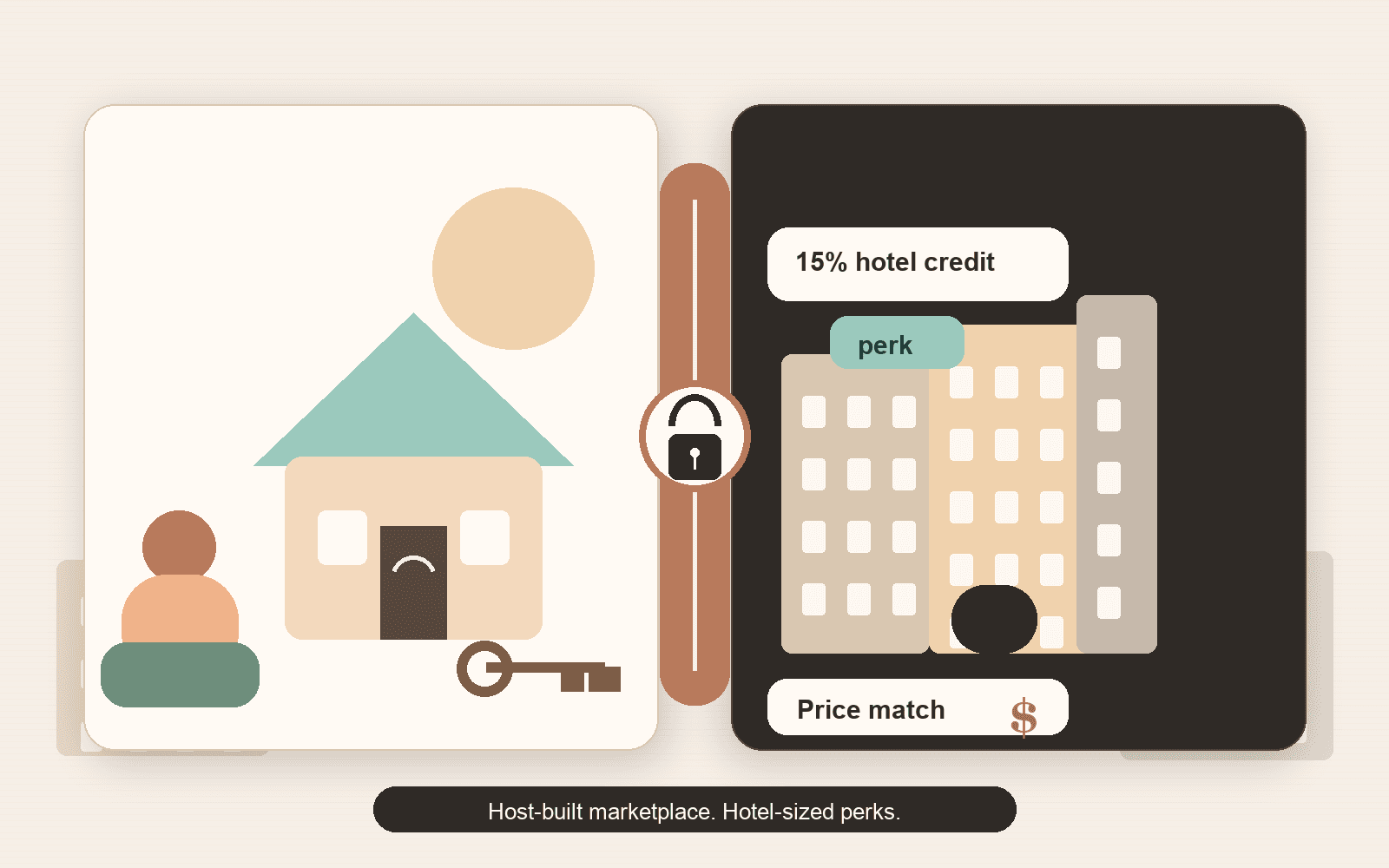
Airbnb did not become Airbnb because of hotels. It became Airbnb because ordinary people opened their homes, took risks, answered guest messages at midnight, replaced stained sheets, refunded entitled travelers, absorbed algorithm changes, fought city regulations, and built the trust that made strangers comfortable sleeping in someone else's house.
Now Airbnb is rewarding guests for booking hotels.
That is not innovation. That is betrayal.
Hosts were not Airbnb's suppliers. Hosts were Airbnb's product.
Hosts Built Airbnb. Hotels Did Not.
Airbnb's own origin story still starts in 2007, when two hosts welcomed three guests into their San Francisco home. That story matters because it was never about a room count. It was about trust. It was about a stranger walking into a real home and deciding the experience felt more personal, more local, and more human than a front desk.
That is what hosts gave Airbnb: the supply, the personality, the neighborhood knowledge, the full kitchens, the handwritten notes, the weird little cabins, the beach houses, the basement suites, the city apartments, the local recommendations, and the feeling that travel could be more than a standardized room.
Airbnb did not spend decades building hotels. Hosts built the inventory. Hosts built the guest trust. Hosts made Airbnb feel different from Expedia, Booking.com, and every hotel site.
Airbnb did not beat hotels because it had better rooms. It beat hotels because hosts made travel feel human again.
Airbnb's Original Promise Was Anti-Hotel
The original emotional pitch was simple: do not just visit a place, live there. Stay in a real home. Meet a real host. Wake up in a neighborhood instead of a lobby. Cook breakfast in a kitchen instead of eating from a buffet line.
That promise worked because hosts made it true. A hotel could offer consistency. Hosts offered character. A hotel could offer a desk clerk. Hosts offered a person who knew where to park, which beach entrance was quiet, which restaurant was actually worth it, and which local rule would ruin a guest's day if nobody warned them.
Airbnb wrapped itself in that host story. It sold the world on belonging, community, and local travel. And hosts believed it because they were the ones making that promise real one guest at a time.
Hosts were the bait. Hotels are the upgrade path.
Then Airbnb Quietly Invited Professional Hospitality In
The hotel shift did not happen by accident, and it did not happen overnight. Airbnb slowly moved from home sharing, to professional hospitality, to hotels, to hotel credits.
In 2018, Airbnb publicly said it wanted to be "for everyone," including professional hospitality providers, and announced changes meant to help hospitality entrepreneurs reach Airbnb guests. That was not a tiny edge case. That was the platform telling the market it was widening the door.
By 2019, Travel Weekly reported that Airbnb's hotel-style inventory had surged, including listings categorized as boutique hotels, B&Bs, hostels, resorts, and other hospitality venues. The reported increase was 152% from the prior year.
That same year, Airbnb signed an agreement to acquire HotelTonight and described the move as part of building an "end-to-end travel platform." In plain English: Airbnb was no longer just protecting the home-sharing lane. It wanted more of the travel wallet.
Airbnb did not accidentally let hotels in. It opened the door, rolled out the carpet, and handed them coupons.
Now Hotel Guests Get Credits Hosts Can Only Dream About
Hosts can accept competition. Most hosts already compete with hotels, professional operators, vacation-rental managers, and every other stay a traveler can book. The real betrayal is not that hotels exist on Airbnb. The betrayal is that Airbnb is now attaching hotel-specific incentives that make hotel bookings look like the smarter deal.
Airbnb's Help Center says that as of May 20, 2026, guests can receive 15% in Airbnb credit after booking eligible hotels in select cities and countries. Airbnb's hotel credit terms also put the maximum credit at $2,000 per eligible reservation.
Airbnb also says some hotel bookings can carry a Price Match Guarantee. If a guest books an eligible hotel room on Airbnb, then finds a lower advertised price for the same room within 24 hours and the claim is validated, Airbnb can issue Airbnb Credit for the difference, up to $400.
HotelTonight users can also earn Airbnb Credit worth 10% of eligible HotelTonight booking value, excluding taxes and fees. That is another hotel-adjacent path that keeps the traveler inside Airbnb's orbit.
So hosts have a fair question: where is the 15% credit for the family-owned cabin? Where is the $400 price-match-style perk for the Superhost with 300 five-star reviews? Where is the loyalty reward for the host who carried Airbnb's brand for eight years?
Airbnb is not just letting hotels compete with hosts. Airbnb is helping hotels look like the better deal.
Airbnb Is Giving Hotels a Better Deal Inside a Host-Built Marketplace
This is the part hosts feel in their gut. Airbnb built a marketplace on the emotional credibility of hosts, then began adding incentives around hotel bookings inside that same marketplace.
A guest shopping for a stay may not care about the history. They see a hotel with a credit. They see a hotel with a price-match promise. They see a familiar booking flow, a check-in desk, and maybe a reward waiting after the trip. Meanwhile, the independent host is told to improve photos, lower prices, simplify fees, respond faster, and be more flexible.
Hosts carry the risk. Airbnb keeps the guest. Hotels get the perks.
That is not a neutral marketplace. That is a platform deciding which behavior to reward.
A One-Property Host Cannot Compete Like a Hotel Chain
Hotels and professional hospitality businesses have structural advantages that ordinary hosts do not. A hotel has revenue managers, multiple rooms, cleaning staff, front desks, maintenance teams, commercial insurance, bulk linen purchasing, dynamic pricing software, and the ability to discount unsold inventory without risking an entire household's income.
A regular host has one property. One calendar. One review score. One cleaning team. One mortgage. One bad guest away from disaster. One algorithm change away from panic.
Airbnb has official standards for hotels and professional hospitality businesses. The platform's recognized categories include hotel, boutique hotel, serviced apartment, aparthotel, hostel, resort, ryokan, nature lodge, and more. These are not random listings sneaking through the side door. They are an acknowledged part of the platform.
That means a one-property host is being compared to businesses with staff, systems, rooms, and capital, then punished by the market when they cannot operate like a hotel.
Airbnb wants hosts to provide the charm of a home, the standards of a hotel, the prices of a motel, and the patience of a saint.
The Rules Are Not the Same for Everyone
Airbnb positions itself as a transparent platform, but hotels can still bring parts of the hotel model with them in ways ordinary hosts often cannot.
Airbnb says hotels may ask guests for a credit card at check-in to cover incidentals or a security deposit, as long as it is disclosed. Airbnb's fee policy also says hotels may request a credit card or cash deposit at check-in for incidentals and may collect certain optional fees directly when that is part of standard hotel procedure.
At the same time, Airbnb says most hosts are not allowed to charge security deposits, while hotels can collect fees and deposits off-platform in certain circumstances.
Airbnb spent years training guests to scrutinize host fees, question cleaning fees, and expect hotel-level flexibility from home hosts. But when hotels enter the platform, suddenly deposits, incidentals, room-type check-in, and hotel-style procedures are treated as normal.
Hosts get lectures. Hotels get exceptions.
When hosts charge fees, guests call it greedy. When hotels do it, Airbnb calls it standard procedure.
Airbnb's Excuse Is "More Choice." Hosts Know Better.
Airbnb will argue that hotels give guests more options. It will say boutique and independent hotels help travelers find places to stay, especially in busy destinations or when homes are booked. It may even argue that hotel guests can eventually become home guests.
That defense misses the host's point.
Hosts are not angry because guests have options. Hosts are angry because Airbnb's loyalty has shifted. The platform is no longer only protecting the host-led marketplace that made it famous. It is trying to capture every possible lodging transaction, even when that transaction sends the guest to a hotel.
Airbnb will say hotels bring more travelers into the ecosystem. Hosts should ask a harder question: if Airbnb is willing to reward a guest for booking a hotel today, what stops it from burying independent hosts tomorrow whenever hotels convert better, cancel less, discount faster, or pay more for visibility?
Airbnb's loyalty is not to hosts. Airbnb's loyalty is to the booking.
Airbnb Became the Travel Machine It Claimed to Replace
Airbnb once felt like the alternative to hotels and online travel agencies. Now it increasingly looks like a hotel-friendly travel marketplace with better branding.
The HotelTonight acquisition was described as part of an end-to-end travel platform. The hotel credit program, hotel search experience, price-match language, and professional hospitality categories all point in the same direction: Airbnb wants to keep every travel dollar inside Airbnb, whether the traveler sleeps in a host's home or a hotel room.
Airbnb still speaks the language of hosts, community, and belonging. But the strategy looks more and more like a booking machine.
Airbnb did not destroy the hotel model. It absorbed it.
Hosts Are Being Turned Into Commodities
The hotel push is not just symbolic. It changes the economics and psychology of hosting.
Hosts lose search visibility when hotels and professional operators enter the same guest journey. Hosts lose pricing power when hotels can offer discounts, credits, loyalty-style perks, and last-minute room deals. Hosts lose differentiation when Airbnb trains guests to compare homes against hotel rooms.
Most of all, hosts lose leverage because Airbnb controls the marketplace, the rules, the algorithm, the guest relationship, the dispute process, and now more of the hotel inventory too.
Airbnb wants hosts to act entrepreneurial, but not independently. Hosts carry the property risk while Airbnb controls the demand.
Hosts own the homes. Airbnb owns the guests. That is the trap.
The host is told to remove friction. The hotel is allowed to operate like a hotel. The host is told to be cheaper. The hotel gets a price-match guarantee. The host is told to create magical hospitality. The hotel gets a checkout credit. The host is told to absorb bad guests gracefully. The hotel gets a front desk, a deposit, and a professional operation.
Airbnb treats hosts like replaceable inventory and hotels like strategic partners.
What Hosts Should Demand Now
Hosts should not end this conversation at anger. They should turn the anger into demands.
Airbnb should create a hard separation between Homes and Hotels in search. It should label hotels and professional hospitality businesses clearly and prominently. It should let guests filter out hotels, serviced apartments, aparthotels, hostels, and professional hospitality businesses.
If Airbnb gives credits for eligible hotel bookings, it should offer equivalent guest credits for independent host bookings. If hotels get price-match-style protection, hosts should get promotional tools that can compete with that same guest psychology.
Airbnb should publish updated data showing whether hotel bookings actually help independent hosts. It should stop using host-centered branding while building hotel-centered incentives. And if Airbnb wants to become Booking.com with nicer fonts, it should say that.
This is not community. This is inventory management.
Airbnb Forgot Who Built the House
Airbnb owes its success to hosts. Not hotels. Not boutique hospitality groups. Not professional operators with revenue managers and front desks. Hosts made Airbnb feel trustworthy. Hosts made it feel personal. Hosts made it feel different.
Now Airbnb is letting hotels onto the platform, giving hotel guests credits, offering hotel price-match guarantees, and asking hosts to pretend this is just more choice.
It is not just more choice. It is a shift in loyalty.
Airbnb used hosts to build a movement. Now it is turning that movement into a hotel marketplace.
And hosts should be furious.
Airbnb did not betray hosts by growing. Airbnb betrayed hosts by forgetting who made it worth growing in the first place.
Frequently asked questions
Does Airbnb allow hotels on the platform?
Yes. Airbnb has official standards for hotels and professional hospitality businesses, including categories such as hotel, boutique hotel, serviced apartment, aparthotel, hostel, resort, ryokan, and nature lodge.
Do some Airbnb hotel bookings qualify for Airbnb credit?
Airbnb's Help Center says eligible hotel bookings in select locations can qualify for Airbnb Credit, including a 15% hotel credit program under specific terms.
Why are hosts upset about Airbnb hotels?
The issue is not that travelers have choices. Hosts are upset because Airbnb built its brand on independent hosts, then added hotel inventory, hotel credits, and hotel price-match perks inside the same marketplace.